
Product photos influence almost every part of an ecommerce store — click-through rate, conversion rate, perceived product quality, and even refund risk.
The problem is that most small ecommerce sellers do not have the time or budget to run professional product shoots for every SKU. Editing hundreds of product images manually is also difficult to scale.
This is where AI product photography tools have become useful.
Some tools focus on simple background cleanup. Others are better for improving lighting consistency, generating product scenes, or creating ad creatives for Shopify, Amazon, Etsy, and social media campaigns.
But not every AI tool is equally useful for ecommerce workflows.
Some platforms are designed for casual photo editing, while others are clearly optimized for product listings, catalog consistency, and marketplace visuals.
In this guide, we compared several AI product photography tools based on real ecommerce use cases:
- Product listing quality
- Background cleanup performance
- Catalog consistency
- Marketing visual generation
- Ease of workflow
- Scalability for larger stores
- Value for ecommerce sellers
If your goal is creating cleaner ecommerce product photos faster — without building a full in-house creative team — these are the tools worth testing.
Quick Recommendations
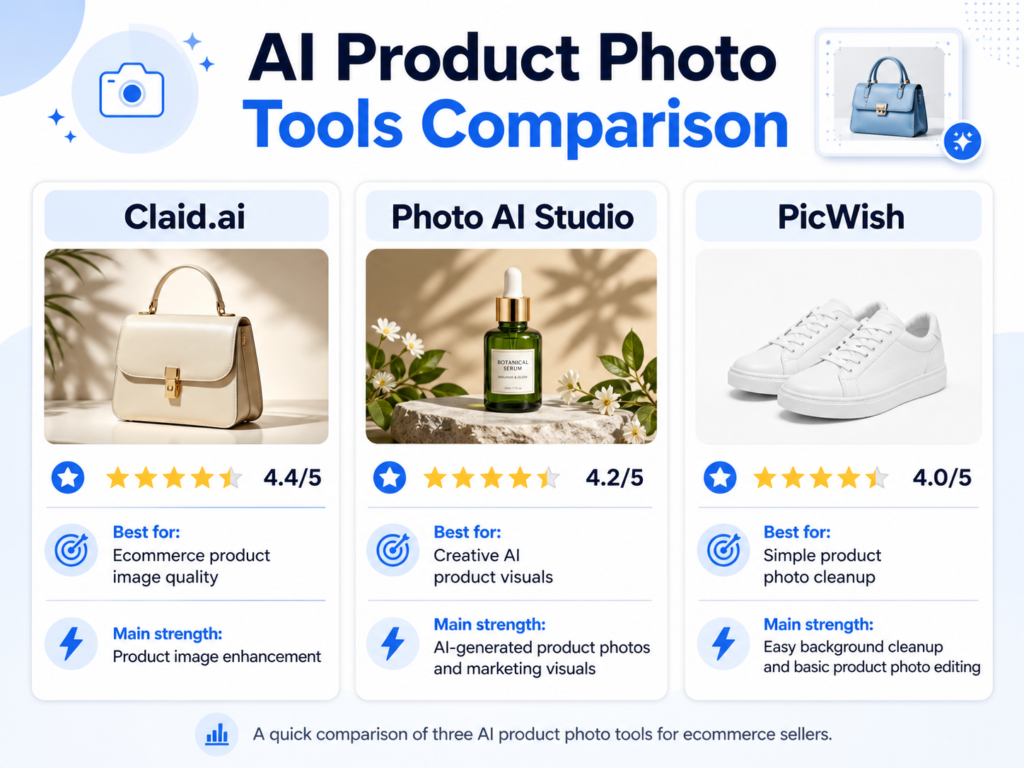
Best Overall for Ecommerce Product Listings
Claid.ai
Best for sellers who care about consistent listing quality, cleaner product presentation, and scalable ecommerce workflows.
Best for Marketing Creatives
Photo AI Studio
Best for AI-generated promotional visuals, ad creatives, and social media product content.
Best Simple Editing Tool
PicWish
Best for quick background removal and lightweight product photo cleanup.
How We Compared These AI Product Photography Tools
Instead of only looking at feature lists, we focused on how useful these tools actually are inside ecommerce workflows.
For example:
- Can the tool handle large numbers of product images efficiently?
- Do the outputs still look realistic after enhancement?
- Are the generated visuals usable for product listings?
- Does the workflow save time compared to manual editing?
- Is the tool more useful for listings or for marketing creatives?
Some AI tools look impressive in demos but become difficult to use consistently across real ecommerce catalogs.
Others are less flashy but much more practical for daily store operations.
1. Claid.ai
Claid.ai is one of the more ecommerce-focused AI product photography tools currently available.
Unlike generic AI image editors, it is clearly designed around product listings and ecommerce image workflows.
The strongest part of Claid.ai is consistency.
For sellers managing many SKUs, keeping product photos visually consistent across a storefront matters more than creating flashy AI-generated scenes. Claid.ai performs noticeably better here than most general-purpose AI editors.
The platform focuses heavily on:
- Product image enhancement
- Background cleanup
- Lighting improvement
- Resolution optimization
- Ecommerce-ready exports
- Workflow automation
It works especially well for:
- Shopify stores
- Amazon listings
- Etsy product pages
- Marketplace catalogs
- Small ecommerce brands scaling inventory
One thing Claid.ai does better than many competitors is maintaining relatively realistic product presentation after enhancement.
Some AI editors over-process images and make products look artificial. Claid.ai generally stays closer to marketplace-friendly visuals.
That matters because ecommerce platforms still prioritize accurate product representation.
Where Claid.ai Works Best
Claid.ai is strongest when:
- Your store has many products
- Listing consistency matters
- You run marketplace ads
- Product presentation directly affects conversion
- You need scalable editing workflows
It is less useful if your goal is highly creative advertising visuals or stylized social media content.
Weaknesses
The platform is still not perfect.
Some generated backgrounds require cleanup, and certain materials — especially reflective surfaces or transparent products — may still need manual correction.
Pricing can also become expensive for stores processing large image volumes.
Final Take
For ecommerce-focused product photography workflows, Claid.ai feels more practical than most generic AI photo editors.
It is one of the stronger options for sellers who care more about scalable listing quality than flashy AI effects.
2. Photo AI Studio
Photo AI Studio is broader and more creatively focused than Claid.ai.
Instead of mainly optimizing product listings, it leans more toward AI-generated marketing visuals and promotional content.
This makes it useful for:
- Social media ads
- Creative campaigns
- Promotional banners
- Lifestyle product scenes
- Branded visuals
The platform is capable of generating much more visually dynamic content than traditional background-removal tools.
For ecommerce brands running paid ads or heavy social media marketing, this flexibility can be valuable.
In practice, Photo AI Studio feels more like a creative production tool than a pure ecommerce listing editor.
That distinction matters.
Many sellers do not actually need cinematic AI product scenes for marketplace listings. They mainly need clean, trustworthy product images that convert well.
Photo AI Studio becomes more useful once marketing creatives become part of the workflow.
Where Photo AI Studio Works Best
The platform works well for:
- Ad creatives
- Product marketing campaigns
- Instagram visuals
- Ecommerce social content
- Promotional product graphics
It is especially useful for brands trying to create more visually engaging campaigns without organizing expensive photoshoots.
Weaknesses
The biggest limitation is consistency.
AI-generated visuals can vary significantly between outputs, which may become difficult when managing larger catalogs or maintaining strict brand consistency.
Some outputs also require additional editing before becoming suitable for ecommerce listings.
Final Take
Photo AI Studio is more useful for creative marketing content than pure product listing optimization.
For stores heavily focused on advertising creatives, it offers much more flexibility than standard ecommerce image editors.
3. PicWish
PicWish focuses on simplicity.
It is not the most advanced AI product photography platform, but it is one of the easiest to start using quickly.
For many smaller sellers, that simplicity is actually valuable.
Instead of learning complex workflows, users can remove backgrounds, clean up product photos, and export listing-ready images within minutes.
The platform is especially useful for:
- Small ecommerce stores
- Beginners
- Side-hustle sellers
- Marketplace resellers
- Etsy shops
- Quick listing cleanup
Compared to Claid.ai, PicWish feels lighter and less workflow-oriented.
It works better for occasional editing than for managing large-scale ecommerce image operations.
Where PicWish Works Best
PicWish is useful when:
- You mainly need background removal
- Your editing workflow is simple
- You upload products occasionally
- You want fast results without complexity
It is also easier for beginners who do not want to learn more advanced ecommerce creative tools.
Weaknesses
The platform becomes limiting once branding and conversion optimization become more important.
Stores heavily focused on premium presentation or large product catalogs will probably outgrow it over time.
It is also less useful for AI-generated marketing creatives.
Final Take
PicWish is practical, beginner-friendly, and fast.
For simple ecommerce product cleanup, it does the job well without requiring complicated workflows.
Which AI Product Photography Tool Is Best?
The best choice depends on how your ecommerce store actually operates.
If your business depends heavily on listing quality and scalable product presentation, Claid.ai is the strongest overall ecommerce-focused option.
If your marketing strategy relies on ad creatives and promotional visuals, Photo AI Studio provides more creative flexibility.
If you mainly need fast cleanup and simple editing, PicWish is the easiest starting point.

Realistic Expectations About AI Product Photography
AI tools can improve ecommerce workflows significantly, but they still require human review.
This is especially true for:
- Product colors
- Texture accuracy
- Material details
- Transparent objects
- Reflective surfaces
- Fashion products
Marketplace platforms still expect product photos to represent the actual product accurately.
Over-editing product visuals can increase customer dissatisfaction and refund rates.
The most effective ecommerce workflows usually combine AI automation with manual review.
FAQ
Can AI product photography tools fully replace photographers?
Not completely.
For premium brands, luxury products, or highly controlled campaigns, professional photography still produces better results.
However, AI tools can reduce editing time and lower content production costs significantly.
Which AI product photography tool is best for Shopify sellers?
Claid.ai is currently one of the stronger options for Shopify sellers because it focuses heavily on ecommerce product image quality and listing consistency.
Which tool is best for beginners?
PicWish is easier to learn and works well for quick product photo cleanup.
Which tool is best for AI-generated marketing visuals?
Photo AI Studio is stronger for creative campaigns, ad creatives, and promotional visuals.
Are AI-generated product images safe for marketplaces?
Usually yes, but sellers should always verify that the final image accurately represents the real product.
Final Verdict
Most ecommerce sellers do not need cinematic AI-generated product art.
They need:
- Cleaner listings
- Better visual consistency
- Faster workflows
- More professional product presentation
That is where AI product photography tools are actually useful.
Claid.ai is currently the strongest option for ecommerce-focused product image workflows.
Photo AI Studio is better suited for marketing creatives and promotional visuals.
PicWish remains one of the easiest beginner-friendly tools for quick cleanup and simple listing preparation.
The best approach is testing these tools with your own products, workflows, and marketplaces instead of relying only on feature lists.
Edith
ok
good